
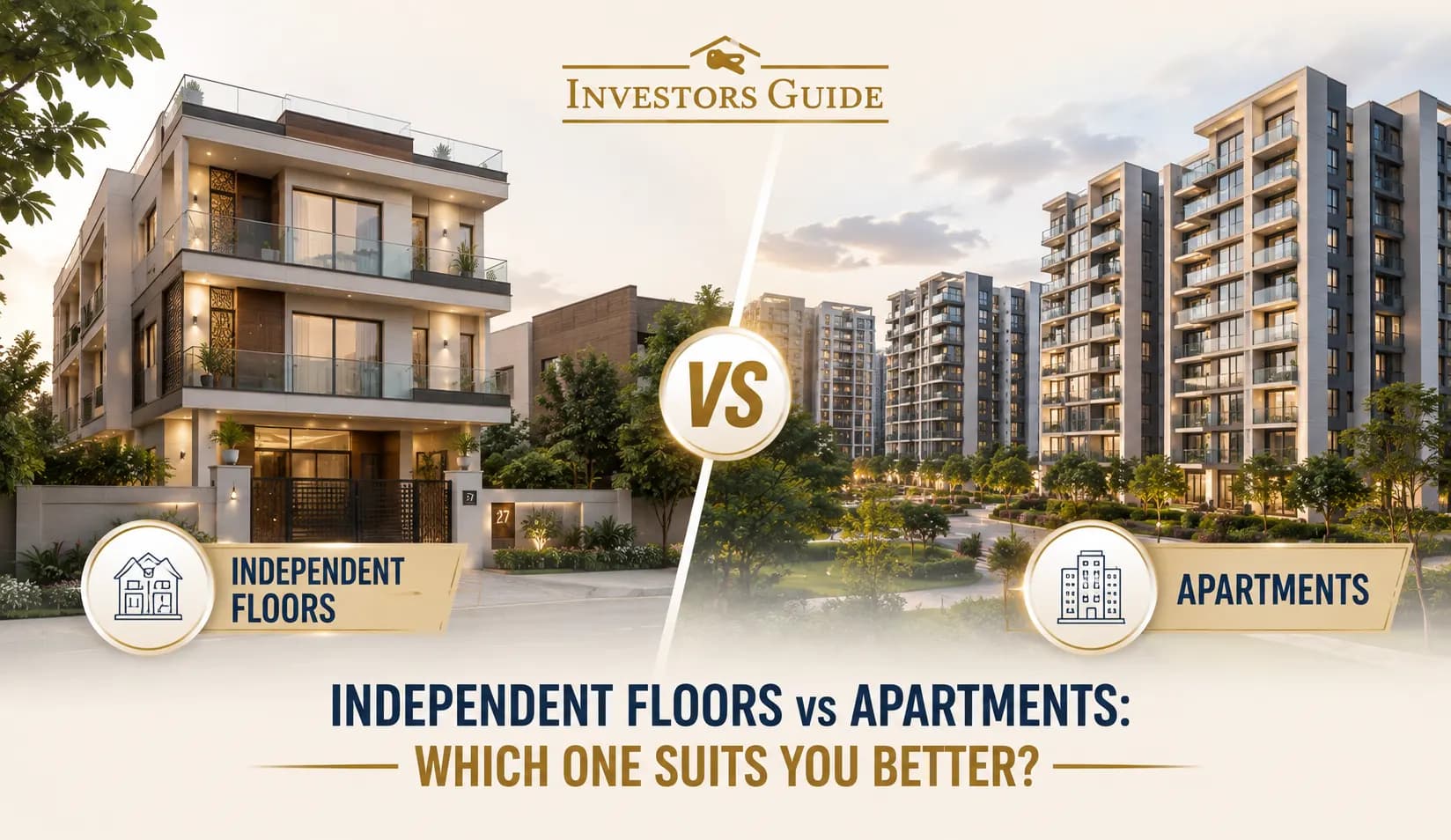
Every second buyer who walks into a real estate conversation in Gurgaon eventually asks the same question: floor or apartment? It sounds like a simple preference, almost like choosing between two paint colours. It isn't. The two options come with genuinely different lifestyles, different cost structures, and different long-term outcomes — and picking the wrong one for your situation is one of the more common regrets we hear about, often two or three years after possession.
So let's actually break this down properly instead of giving you the usual "it depends" non-answer.
What You're Really Choosing Between
An apartment puts you inside a larger complex — shared lifts, shared amenities, a managing society, and neighbours stacked above and below you. An independent floor gives you one full floor of a low-rise building, usually 3 to 4 floors total, with your own entrance in most cases and none of the shared-building dynamics that come with a high-rise.
That's the surface-level difference. The real differences show up once you actually live with either choice for a while.
Where Independent Floors Win
Privacy is the biggest one. No shared lifts, no waiting for your turn, no random neighbours in the corridor outside your door. For a lot of buyers, especially families who've lived in independent houses before and are downsizing, this matters more than any amenity list.
Lower maintenance costs. Without a large clubhouse, multiple lifts, and extensive common area staff to fund, monthly maintenance on a floor typically runs a fraction of what a comparable apartment in a high-rise society costs. Over a decade, that difference adds up to a meaningful sum.
More control over your own space. Want to modify your kitchen layout or add a small extension within your floor's footprint? You generally have more flexibility here than in an apartment, where society rules and structural constraints are tighter.
If this sounds like your priority, projects like CS Realty Flamingo 70A are worth a serious look. It's built specifically around this low-density, privacy-first approach — fewer units per building, more usable floor area, and a layout that feels closer to an independent house than a typical stacked development. For buyers coming from Delhi's independent-house culture who don't want to compromise on that feel, this is exactly the kind of project that bridges the gap.
A little further out, Laburnum Victory Floors 89 takes a similar low-rise approach but leans harder into open, green surroundings — larger setbacks, more breathing room between buildings, and a quieter, more residential feel overall. It tends to appeal to buyers who want the floor lifestyle but aren't willing to trade away green space to get it.
Where Apartments Win
Amenities you simply can't get on a floor. Swimming pools, full-scale clubhouses, dedicated kids' play areas, jogging tracks, multiple sports courts — this level of infrastructure only makes financial sense when spread across hundreds of units. No independent floor development can realistically match it.
Security, without you managing it. Gated entry, CCTV coverage, dedicated security staff, and visitor management systems come standard in most apartment complexes. On a floor, you're often responsible for arranging and funding this yourself.
Better rental demand in a lot of micro-markets. Corporate tenants and young professionals frequently prefer apartments — the amenities and managed-society structure feel more familiar and lower-maintenance to someone who isn't planning to stay long-term.
Higher resale liquidity, generally. Apartments in well-known societies tend to have a larger buyer pool at resale time, simply because more people are actively looking for that format compared to independent floors.
If this list matches what you're after, Conscient Parq is a strong example of what modern apartment living looks like at this end of the market — a full amenity stack, professional facility management, and a scale that supports the kind of lifestyle infrastructure a floor simply can't offer.
Suncity Monarch takes a slightly different angle within the apartment category — it's built more around long-term end-user comfort than flashy amenities, with an established society and a track record that's already playing out in the resale market. For buyers who want the apartment format but are wary of newer, unproven developments, that track record carries real weight.
The Cost Comparison Nobody Talks About Upfront
On paper, floors often look cheaper per square foot than comparable apartments in the same micro-market. But the full cost picture includes more than the purchase price.
Apartments bundle amenities into the price — you're paying for the clubhouse and pool whether you use them or not, and that cost is baked into both the purchase price and ongoing maintenance. Floors strip that out, which lowers the entry price and the monthly outgo, but only if you don't miss those amenities enough to seek them out elsewhere.
Resale timelines are worth factoring in too. Apartments in established societies tend to sell faster because the buyer pool is larger. Floors, particularly well-built ones in good locations, can take a bit longer to find the right buyer — though they often don't sell at a discount once they do, since the buyer pool that specifically wants a floor is more deliberate about it.
So, Which One Actually Suits You?
Choose an independent floor if: you value privacy over amenities, you're planning to stay long-term rather than optimizing for quick resale, you want lower monthly maintenance, and you don't mind managing a few things yourself instead of outsourcing them to a society.
Choose an apartment if: amenities and lifestyle infrastructure matter to you, you want built-in security without managing it, you're renting the property out or might sell within 5-7 years, or you simply prefer the convenience of a managed community over independent upkeep.
There isn't a universally "better" answer here — only a better answer for your specific situation, budget, and how you actually plan to live in or use the property.